ไทย
ไทย 中文 (中国)
 العربية


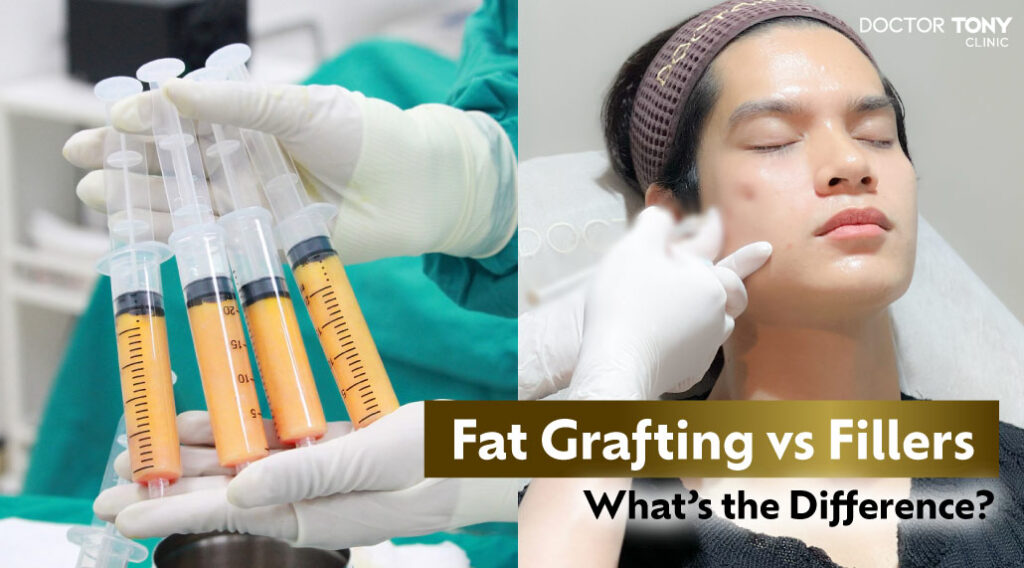
When it comes to restoring youthfulness or enhancing facial contours, two of the most popular options are dermal fillers and autologous fat grafting face (using your own fat). While both methods add volume to the face, the procedures, materials used, and long-term results are significantly different. Understanding these differences is key to making the right choice.
Key Takeaways
- Fat Grafting Face uses your own fat cells. Results are semi-permanent and can last for years. However, expect 5–14 days of downtime, and keep in mind that 30–50% of the injected fat may be reabsorbed by your body within the first few months (survival rate is not 100%).
- Fillers are made from synthetic Hyaluronic Acid (HA) . Results last 6–24 months with zero downtime. If you’re unhappy with the outcome, they can be dissolved immediately. Fillers provide sharp, defined results and are ideal for fine details and specific areas.
- Choose Fat Grafting if you want large-volume enhancement, long-lasting results, skin rejuvenation benefits, and are comfortable with some unpredictability and recovery time.
- Choose Fillers if you want fast results, predictable outcomes, the ability to reverse the treatment, and no downtime.
- Good to know: Fat Grafting is more cost-effective in the long run for treating large areas. Fillers are more cost-effective for detailed sculpting and offer greater flexibility for adjustments.


What Is Fat Grafting Face (Using Your Own Fat)?
Fat grafting uses your body’s own fat cells. A doctor first liposuction excess fat from areas like the abdomen, thighs, or hips. The fat is then purified to isolate healthy, viable cells before being injected into the face.
Key Advantages of Fat Grafting face
- Complete Biocompatibility: Since it’s your own tissue, there’s zero risk of allergic reaction or rejection.
- Semi-Permanent Results: Fat that survives (and develops a new blood supply) becomes a permanent part of your facial tissue.
- Skin Rejuvenation: Fat contains stem cells and growth factors that improve skin quality, leaving treated areas looking fresher and more radiant.


What Are Dermal Fillers?
Most modern filler are made from Hyaluronic Acid (HA) – a substance naturally found in the body. HA is synthetically produced as a gel with varying thickness and elasticity. This allows doctors to choose the right type for each area: firmer fillers for chins or cheekbones, and softer ones for under-eyes or lips.
Key Advantages of Fillers
- Safety: Authentic, FDA/WHO-approved fillers dissolve naturally over time (6–24 months). Importantly, if results are unsatisfactory, they can be immediately dissolved using Hyaluronidase.
- Precision: Ideal for sculpting fine details and achieving sharp, defined results.
Procedure & Recovery Time Comparison
This is one of the biggest differences affecting your daily life.
Aspect | Dermal Fillers | Fat Grafting |
Procedure time | 30–45 minutes | Longer (includes liposuction + injection) |
Downtime | None – return to normal activities immediately | 5–14 days for swelling/bruising to subside (both donor & recipient sites) |
Invasiveness | Minor (just injections) | Semi-surgical (requires liposuction) |
Long-Term Results & Longevity
Dermal Fillers (HA)
- Longevity: Temporary, 6–24 months depending on type and area.
- Touch-ups needed: Yes, to maintain results.
- Best for: Fine detail correction, deep folds, sharp facial contours.
Fat Grafting
- Longevity: Semi-permanent (survived fat lasts for years).
- Touch-ups needed: Possibly 1–2 sessions, as 30–50% of injected fat is naturally reabsorbed in the first few months.
- Best for: Adding volume to larger areas, restoring overall softness and youthfulness.


Important Considerations Before Choosing
- Budget & Volume: For large-volume facial enhancement, fat grafting is more cost-effective long-term than buying many syringes of filler.
- Predictability: Fillers offer predictable, precise results. Fat grafting has more variability (final volume depends on how much fat survives).
- Reversibility: Fillers can be dissolved immediately if needed. Overfilled or lumpy fat is much harder to correct (may require small surgical removal).
Frequently Asked Questions (FAQ)
Fat uses your own cells – very natural, longer-lasting. Fillers use lab-made HA – instant results, easily reversible.
Well-established fat can last semi-permanently (many years) without frequent touch-ups.
Fillers gradually dissolve over 6–24 months, depending on type and treatment area.
Almost impossible – it’s your own tissue, not a synthetic substance.
Yes, when using authentic, approved fillers and an experienced doctor. Counterfeit fillers can cause allergies or vascular blockage.
Typically 5–14 days, as both liposuction and injection sites need healing.
It depends on your goals, budget, and available downtime.
Choose fat grafting for long-lasting, natural volume and skin quality improvement, and if you can accept some recovery time.
Summary
Choose dermal fillers for fast, precise, and reversible results, especially for sharp contours like the jawline or chin. Choose fat grafting if you want semi-permanent volume, natural feel, skin rejuvenation, and better value for larger areas – but be prepared for downtime and some unpredictability in how much fat survives.
Read this article in Thai: ฉีดฟิลเลอร์ กับ ฉีดไขมัน ต่างกันอย่างไร?
Thank you for the information referenced from the website : PubMed